
 Margin Pro
 Retail 365
 AI Operator
 Seller 365
 UniCon
 Onsite Support


 Blog
Blog How to sell on SHEIN Marketplace from Amazon in 2026.
If you’re already selling on Amazon, the challenge in expanding to SHEIN Marketplace isn’t getting approved. It’s maintaining consistency once you’re live.

If you’re already selling on Amazon, expanding to SHEIN Marketplace starts before you create a single listing. It begins with whether your business meets the platform’s requirements.
SHEIN is selective, and its listing structure is more prescriptive than most marketplaces. Your Amazon catalog won’t transfer directly, and your operations need to support another channel from day one.
The failure point isn’t listing. It’s in trying to adapt an existing Amazon catalog and workflow to a platform that expects a different level of structure.
To sell on SHEIN Marketplace from Amazon, you need to:
- adapt your catalog to SHEIN’s listing format
- meet eligibility and onboarding requirements
- set up fulfillment that meets delivery expectations
- keep inventory and orders aligned across channels
The challenge isn’t getting approved. It’s maintaining consistency once you’re live.
What SHEIN Marketplace is.
SHEIN started as a fast-fashion retailer selling its own products. Its third-party marketplace launched in the US in 2023 and has since expanded into multiple regions.
The model is straightforward. You list products, set pricing, and manage inventory. SHEIN provides the storefront, traffic, and optional fulfillment, similar to Amazon.
It’s closer to Amazon’s marketplace than to Temu’s consignment model. But the audience, discovery mechanics, and listing requirements are different enough that you can’t treat it as a copy of your Amazon operation.
Eligibility is the first constraint.
SHEIN is more selective than most marketplaces.
You need to be a registered business. Individual sellers aren’t accepted. Revenue thresholds are commonly cited in the multi-million range, though they vary by category and region. You also need to ship from US-based inventory for the US marketplace.
Compared to other marketplaces, this is a higher bar. TikTok Shop and Temu are more accessible for initial expansion, while Walmart sits somewhere in between with selective approval but broader acceptance for established sellers.
SHEIN is not designed for early-stage sellers. It targets established operators who can meet its standards consistently.
For established Amazon sellers, this aligns well. You already have inventory, fulfillment, and product data. The constraint is whether your products fit the platform and whether your operations can support another channel.
The fee structure is simple, but efficiency matters.
SHEIN charges a flat 10% commission. There are no listing fees or subscription costs. New sellers often receive a short introductory period with reduced commission.
Compared to Amazon’s layered fees, the structure is simpler. For the right products, margins can be better.
But the economics only work if fulfillment and delivery are consistent. Orders that miss delivery expectations can incur penalties, and shipping decisions directly affect profitability.
SHEIN listing requirements have their own structure.
Your Amazon listings won’t transfer directly.
SHEIN uses a prescriptive title format with defined structure and shorter limits. That’s a shift from Amazon’s keyword-heavy titles.
Image requirements are stricter. The platform is built around browsing and visual discovery, so product presentation matters more than on search-driven marketplaces.
Category mapping is also different. SHEIN uses its own hierarchy, variation rules, and required attributes. Missing or incorrect data prevents listings from going live.
For a small catalog, this is manageable manually. At scale, it becomes the main bottleneck.
The challenge isn’t just translating listings once. It’s maintaining them as your catalog changes across multiple marketplaces.
The catalog translation problem is consistent across marketplaces. TikTok Shop requires different attribute structures, while Walmart emphasizes listing quality and compliance.
If each channel has its own version of your catalog, inconsistencies build quickly. Updates don’t propagate, attributes drift, and listings fall out of sync.
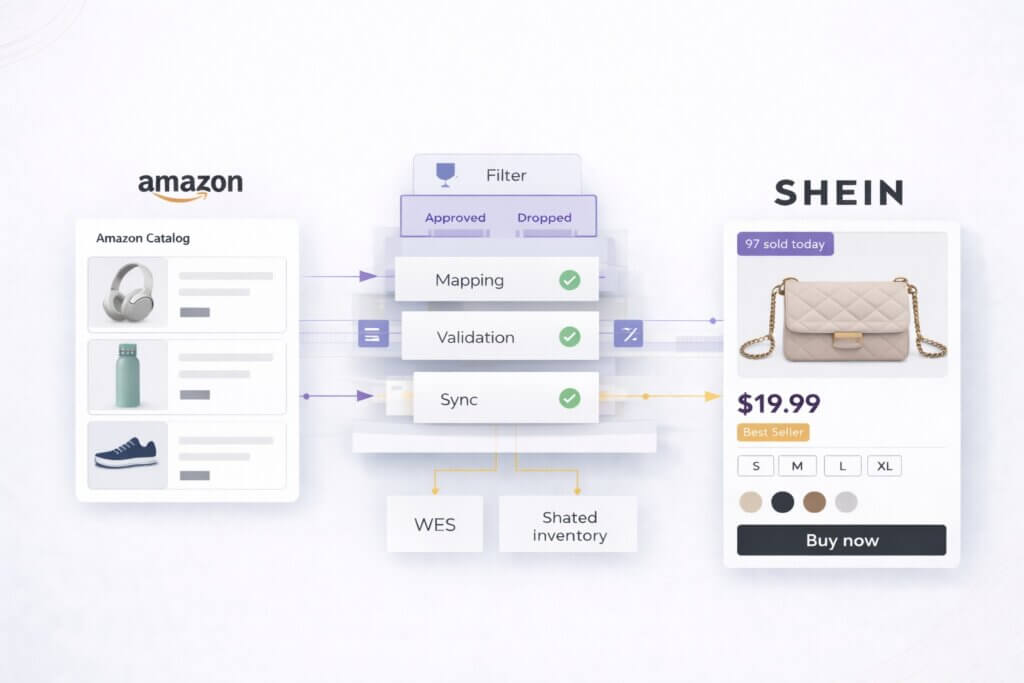
Most sellers operating across multiple channels use tooling to handle this. CedCommerce by Threecolts supports SHEIN natively, mapping your existing catalog into SHEIN’s required structure, validating listings before submission, and maintaining those mappings over time.
This turns catalog translation from a one-off task that quickly becomes inconsistent into an ongoing system.
SHEIN fulfillment offers flexibility.
SHEIN offers several fulfillment paths.
You can self-fulfill, use a 3PL, route orders through Amazon MCF, or use SHEIN’s own fulfillment service if you qualify.
For Amazon sellers, MCF is often the simplest starting point. You can use your existing Amazon inventory and fulfillment network without building new infrastructure.
The complexity shows up when you’re operating across channels. If Amazon, Walmart, and SHEIN orders are all pulling from the same inventory, fulfillment decisions need to be consistent.
Which warehouse fulfills which order, how shipping costs are managed, and how delivery expectations are met can’t be handled separately per marketplace.
That routing needs to be managed centrally. Platforms like CedCommerce handle this by applying consistent routing logic across channels. Otherwise, you end up with conflicting decisions across channels and unpredictable delivery performance.
Inventory sync and multi-channel complexity.
As you add SHEIN alongside Amazon and other channels, inventory becomes a coordination problem.
Multiple channels are now drawing from the same stock. If updates aren’t immediate, you risk selling inventory that’s no longer available.
Returns introduce further complexity. Items can move back into stock at different times depending on the channel.
The requirement is maintaining a consistent inventory position across all systems.
CedCommerce supports this by treating inventory as a single state. Updates propagate in real time, conflicts are resolved automatically, and failed operations are retried.
Without that, differences between channels accumulate, and accuracy breaks down over time.
Managing order flow.
SHEIN introduces a separate order workflow that needs to align with your existing operations.
Each order must move from SHEIN into your fulfillment process and back again with valid tracking.
Breakdowns tend to happen at system boundaries. Orders may not reach fulfillment, may fail validation, or may not return tracking correctly.
These issues are often delayed. They appear later as missing orders, tracking gaps, or performance issues.
CedCommerce manages this by retrying failed orders and making their status visible.
Without that, order handling becomes fragmented across systems and requires manual reconciliation.
What to list first.
Don’t start with your full catalog.
Start with a focused set of products that:
- fit SHEIN’s requirements
- have strong visual presentation
- maintain margin at competitive pricing
This lets you validate listing structure, fulfillment, and inventory behavior before scaling.
Once the system is stable, expanding the catalog becomes incremental.
A realistic timeline.
For sellers using a multichannel platform to handle mapping and synchronization, a typical rollout looks like:
Week 1: Apply through SHEIN’s seller portal and complete onboarding.
Week 1–2: Connect your catalog to your multichannel platform, configure mapping, and prepare listings.
Week 2–3: Submit listings and resolve validation feedback.
Week 3–4: Listings go live. Validate fulfillment, tracking, and inventory sync.
Without a system handling catalog translation and synchronization, this process takes significantly longer due to manual mapping and ongoing maintenance.
What this comes down to.
SHEIN Marketplace is not an open channel. It expects structured data, consistent operations, and products that fit its model.
Your Amazon catalog, inventory, and fulfillment can carry over, but they need to meet those expectations and stay consistent across systems.
The sellers who succeed treat SHEIN as part of a broader operation. They maintain structured product data, keep inventory accurate, and ensure orders flow reliably across channels.
Platforms like CedCommerce make that possible by acting as the system between your catalog and each marketplace.
Without that, each additional channel increases complexity rather than reducing it.