

 Margin Pro
 Retail 365
 AI Operator
 Seller 365
 UniCon
 Onsite Support


 Blog
Blog Best accounting software for Amazon sellers in 2026
Most accounting tools weren’t built for Amazon’s fee complexity.


Amazon’s fee structure is uniquely complicated. You’re not just tracking revenue and expenses. You’re reconciling referral fees, FBA fulfillment fees, storage costs, reimbursements for lost inventory, promotional discounts, returns, and multi-channel payouts, all landing in your bank account as a net settlement that tells you almost nothing by itself.
In 2026, Amazon raised FBA fulfillment fees across the board, effective January 15, with increases varying significantly by product size and price point. Standard-size items priced $10 to $50 saw an average increase of $0.08 per unit, while small items priced above $50 jumped by $0.51 per unit. Large products priced below $10 saw no change at all. Then, on April 17, Amazon added a 3.5% fuel and logistics surcharge on top of all FBA fulfillment fees for US and Canadian orders, including Multi-Channel Fulfillment to Canada, Mexico, and Brazil. For sellers moving high volumes, these stack up fast. The sellers who know their true margins make better decisions. The ones who don’t eventually find out the hard way.
Why standard accounting software falls short for Amazon sellers
Standard bookkeeping tools such as QuickBooks, Wave, and even basic Xero were built for businesses with straightforward revenue streams. You sell something, you get paid, you record it. Amazon doesn’t work like that. Your bi-weekly payout is a net figure that bundles dozens of transaction types, and dropping it into a generic income account produces financials that are essentially useless.
You can’t see your actual COGS, you can’t identify which ASINs are profitable, and you definitely can’t prep for taxes without manually reconstructing everything. The specific challenges standard tools struggle with include:
- FBA fees that vary by product size, weight, category, and time of year. Peak storage rates are triple standard rates, and new fee tiers for bulky and oversize items add further complexity.
- Inbound defect fees that now range from $0.32 to $5.72 per unit for shipment errors (up from $0.02 to $0.07 in prior years), making shipment accuracy a direct accounting line item for the first time.
- Low-inventory-level fees of $0.32 to $0.97 per unit charged when your FBA stock covers fewer than 28 days of historical sales velocity.
- Reimbursements for lost or damaged inventory that can run months behind the original loss.
- Returns that create separate accounting entries affecting both revenue and inventory values.
- Multi-channel revenue from different platforms with different fee structures.
- COGS tracking that requires cost-per-unit data tied to specific shipments.
What to look for in Amazon accounting software
Before comparing tools, clarify what you actually need:
COGS and inventory tracking: Most accounting tools track cash, not inventory. If you’re buying products to resell, you need COGS tied to units sold, not just what you paid when you bought them.
FBA fee reconciliation: The software should break down Amazon settlement reports into individual line items, including fees, refunds, promotions, and reimbursements, and automatically map each transaction to the correct account.
Tax compliance: Sales tax nexus has become significantly more complex since South Dakota v. Wayfair (2018), the Supreme Court ruling that established “economic nexus,” meaning states can now require sales tax collection from remote sellers who meet revenue or transaction thresholds, even with no physical presence in that state. Your software should handle multi-state sales tax reporting or integrate cleanly with a dedicated tax tool.
Integration depth: Some tools pull from Amazon’s reports; others use the Selling Partner API. SP-API connections deliver cleaner, more granular data faster.
The best accounting software options for Amazon sellers
A2X
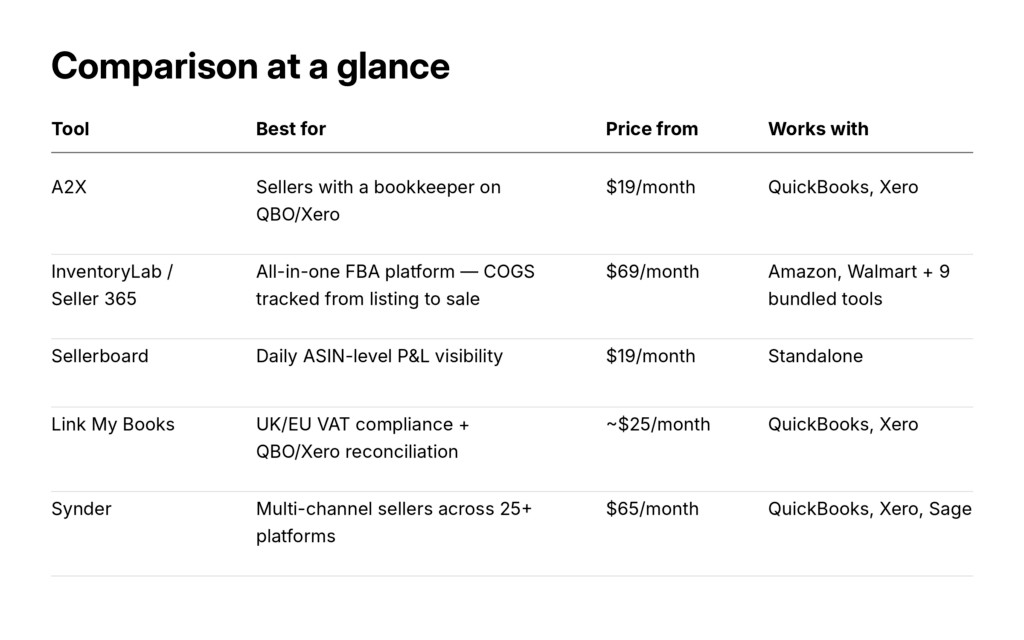
A2X is a connector tool that sits between Amazon (or Shopify, eBay, Etsy, Walmart) and your accounting software of choice, including QuickBooks Online and Xero. It breaks down Amazon’s settlement reports into itemized entries: sales, refunds, FBA fees, advertising costs, reimbursements, each mapped to the correct account automatically.
For sellers already committed to QuickBooks or Xero who want clean Amazon data without manual reconciliation, A2X is the professional standard in this space. Pricing starts at $19/month for one channel, scaling with order volume.
InventoryLab Accounting
InventoryLab Accounting (part of Seller 365) is built specifically for FBA sellers and is the only tool on this list that captures COGS before the sale happens. When you list a product, you enter the unit cost, and that number follows the inventory all the way through to the payout. There’s no settlement reconciliation gap because the data was never separated in the first place.
It’s bundled inside Seller 365 at $69/month alongside nine other tools including Tactical Arbitrage for product sourcing, SmartRepricer for automated pricing, and FeedbackWhiz for review management. If you’re currently paying separately for a repricer, a sourcing tool, and a profit tracker, you’re likely already past $69/month.
Sellerboard
Sellerboard is a popular standalone profit analytics tool that gives sellers a real-time view of their P&L, broken down by ASIN, including FBA fees, advertising costs, refunds, and promotions. It’s not a full accounting platform (it won’t push journal entries to QuickBooks), but for sellers who need daily operational visibility into what’s actually profitable, it’s one of the cleanest options available. Plans start at $19/month.
Link My Books
Link My Books focuses on Amazon-to-accounting integration and is particularly strong for UK and European sellers dealing with VAT, automatically applying the correct tax rates across jurisdictions that trip up other tools. US sellers will find the payout reconciliation and QuickBooks/Xero integration fully functional too. Pricing starts around $25/month.
Synder
Synder is a multi-channel ecommerce accounting automation platform that handles Amazon alongside Shopify, WooCommerce, Stripe, and 25+ other platforms. It breaks down payouts into product sales, fees, shipping income, sales tax, and more, mapping each element to the correct account in real time with multicurrency support. Best suited to sellers where Amazon is one of several meaningful revenue channels. Pricing starts at $65/month.
Why FBA fee complexity makes accounting harder in 2026
Amazon’s 3.5% fuel and logistics surcharge added in April 2026 compounds with January’s fulfillment fee increases which range from no change on some products to $0.51 per unit on small items above $50. For a seller moving 5,000 standard-size units a month, that’s $400/month or more in additional fulfillment costs before storage enters the picture.
Storage fees create another layer. Standard monthly rates run $0.78 per cubic foot (January to September), jumping to $2.40 per cubic foot from October through December. That’s more than triple the standard rate. If you’re holding inventory heading into Q4 without a plan, your accounting software needs to help you model the cost impact before the bills arrive, not after.
Aged inventory surcharges add a third layer, kicking in at 181 days and escalating to $5.45/cu ft at 271 days, $6.90/cu ft at 366 days, and a new $7.90/cu ft tier for inventory beyond 456 days, added in January 2026.
Two new fee types round out the picture: inbound defect fees jumped from $0.02 to $0.07 to $0.32 to $5.72 per unit for shipment errors, and low-inventory-level fees of $0.32 to $0.97 per unit kick in when stock falls below 28 days of coverage. Software that tracks all of these as distinct line items and flags thresholds before they’re breached is no longer optional for any seller running real volume.
How to match the right tool to your business
The best accounting software for Amazon sellers isn’t the same for everyone:
- If you have a bookkeeper or CPA: A2X plus QuickBooks Online is the professional standard for US sellers. Your accountant already knows QBO, and A2X pushes clean, categorized journal entries that make month-end reconciliation fast. UK and European sellers should pair Link My Books with Xero or QBO for the same result with built-in VAT handling.
- If you want COGS tracked from day one: InventoryLab Accounting (via Seller 365) is the only tool here that captures cost at listing, not after the payout. At $69/month it also replaces your repricer, sourcing tool, and review manager.
- If you just want to know what’s profitable: Sellerboard gives you real-time ASIN-level P&L with the fastest setup in this group, no full accounting workflow required.
- If you’re a UK or European seller without a CPA: Link My Books is the most straightforward path to VAT-compliant books without a full accounting setup.
- If you sell across multiple platforms: Synder unifies Amazon with Shopify, WooCommerce, Etsy, and 25+ other channels under one accounting workflow.
The one habit that matters more than the software
Whatever tool you choose, reconcile your Amazon settlements monthly. Most sellers who run into accounting disasters weren’t using the wrong software. They just weren’t using it consistently.
Set a calendar reminder, pull the settlement report, and verify that what hit your bank account matches what your accounting software shows. Given the number of distinct fee types now hitting every settlement, including fulfillment fees, storage fees, inbound defect fees, low-inventory surcharges, and aged inventory penalties, this monthly check is more important than ever.
The bottom line
Amazon’s fee structure will keep getting more complex, not less. The 2026 changes include higher fulfillment fees, the April fuel surcharge, steep inbound defect penalties, and escalating aged inventory surcharges. Together, they mean that sellers who track only their bank balance are flying blind. The FBA sellers who stay profitable are the ones who know their actual margin on every ASIN.
If you’re still dropping Amazon payouts into a single income line, pick one of the tools above and fix that before your next product launch. If you’re looking to consolidate your Amazon tech stack, InventoryLab Accounting comes bundled with Seller 365 alongside nine other tools, covering inventory management, repricing, sourcing, and profit analytics, for $69/month. It’s worth comparing that against the sum of what you’re currently paying.