


 Blog
Blog How Amazon MCF powers fulfillment across every marketplace you sell on
For Amazon FBA sellers, using Multi-Channel Fulfillment can make it easier to sell through new marketplaces. But it doesn’t always make sense. Find out when it does and doesn’t work.

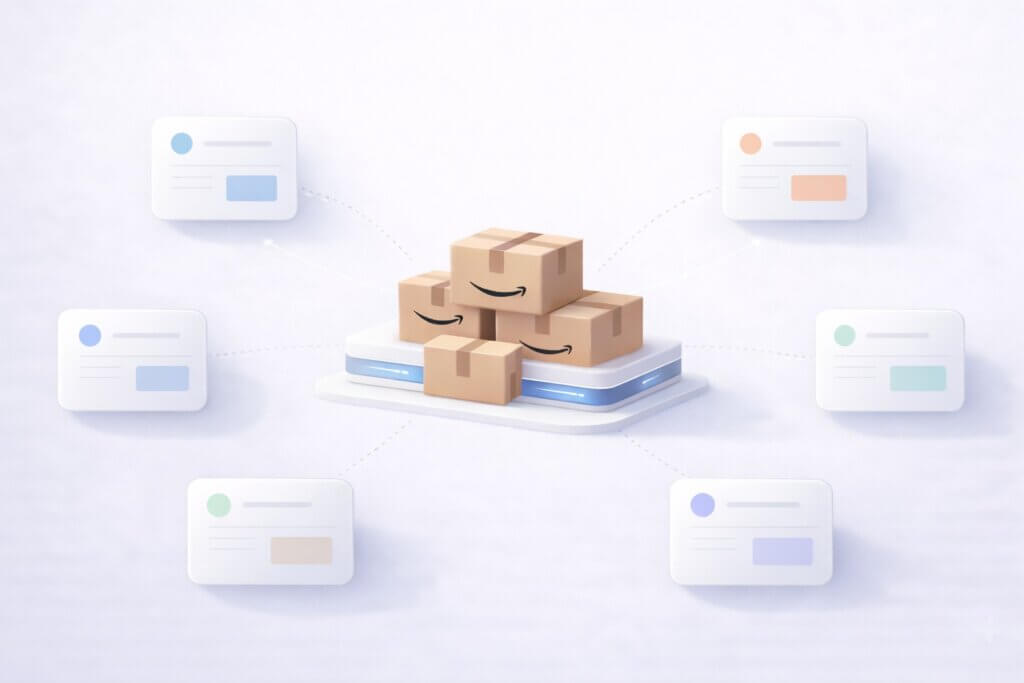
Amazon Multi-Channel Fulfillment (MCF) lets you use your existing FBA inventory to fulfill orders from other sales channels.
That includes TikTok Shop, Temu, SHEIN, Walmart, Shopify, and your own website. Amazon handles picking, packing, and shipping using the same infrastructure that powers Prime delivery.
For Amazon sellers expanding off-platform, MCF removes the need to build a second fulfillment operation. But the economics changed in 2026, and it’s worth understanding exactly where it works and where it doesn’t.
How MCF actually works
The model is simple.
You already hold inventory in Amazon’s fulfillment centers. When an order comes in from another channel, your system routes it to Amazon through the MCF API. Amazon then fulfills it from the same inventory pool.
A typical flow looks like this:
- A customer orders on TikTok Shop
- Your system sends the order to Amazon
- Amazon picks, packs, and ships
- Tracking flows back to the marketplace
The customer gets a 2–3 day delivery experience. You manage one inventory pool instead of splitting stock across warehouses.
Amazon ships MCF orders using a mix of carriers, including Amazon Logistics, UPS, and USPS. Packaging is unbranded, so the customer doesn’t see Amazon branding.
You don’t need to be an Amazon seller to use MCF. But for FBA sellers, the advantage is consolidation. One inventory pool serves every channel.
The 2026 pricing reality
MCF has always cost more than standard FBA fulfillment. In 2026, that gap widened.
Amazon increased MCF fees in January 2026. Single-unit orders saw the largest increases, around $0.35–$0.41 per unit. Multi-unit orders saw smaller increases or none at all.
A small standard item (under 1 lb) now costs roughly $6.59 per unit to fulfill via MCF at standard speed. At 10 lbs, that rises to around $13.29.
However, Amazon also introduced the Preferred Pricing program to offset some of these increases. There are two structures to it:
- A short-term program offering ~15% off fulfillment fees plus $1 per-unit FBA credit
- A tiered program where discounts increase with volume
At higher volumes, these incentives shift the margin math.
Amazon also waived its 5% surcharge on Walmart orders through 2027. That removes a previous penalty for sellers fulfilling Walmart orders via MCF.
One important nuance: multi-unit orders get significant discounts. In some cases, per-unit costs drop by up to 50%.
When MCF makes sense
MCF works best in a few specific scenarios.
If you’re already on FBA and adding channels, it’s the fastest way to start. You don’t need a second warehouse or separate inventory pool.
If your products are lightweight and priced above $20, the margin structure usually works. Below that, fulfillment costs eat too much of the margin.
If your off-Amazon orders often include multiple items, the economics improve quickly due to multi-unit discounts.
Speed also matters. MCF delivers in 2–3 days with tracking, which helps maintain compliance on channels like TikTok Shop and SHEIN.
There’s also a conversion angle. Amazon extended MCF fast-delivery badges to placements like Google Shopping and TikTok ads. Showing delivery speed at the point of click can improve conversion rates.
When MCF doesn’t make sense
MCF is not the lowest-cost option.
For heavier products, the economics break quickly. At around 3 lbs or more, it’s worth comparing with a 3PL. At 10 lbs, MCF can cost nearly double the typical 3PL rates.
When you hit higher volumes, you’re paying for convenience. A dedicated 3PL will usually win on cost, but requires more operational overhead.
Packaging is another limitation. MCF uses unbranded packaging, which works for marketplaces but not for D2C experiences.
Walmart adds constraints as well. Since Walmart doesn’t allow Amazon Logistics, MCF has to route through other carriers. The surcharge is waived for now, but the restriction still exists.
Where MCF fits in your stack
MCF is not a standalone strategy. It’s one fulfillment option inside a broader multichannel setup.
Most sellers end up using a mix:
- MCF for fast marketplace fulfillment
- A 3PL for heavier or lower-margin products
- Direct fulfillment for branded D2C orders
The question isn’t whether to use MCF. It’s where to use it.
How MCF fits into your multichannel operations
MCF works best when it runs inside an automated system.
Without that, you’re manually creating fulfillment orders in Seller Central and copying tracking numbers back to each marketplace. That doesn’t scale.
With a multichannel platform, the flow becomes automatic.
An order comes in from TikTok Shop or Temu. The system routes it to Amazon MCF. Tracking flows back to the marketplace. Inventory updates across channels.
You don’t touch it.
CedCommerce by Threecolts integrates MCF directly into this flow. When an order comes in, the platform handles routing, carrier mapping, and tracking sync automatically.
Setup involves mapping carriers and defining routing rules. After that, orders move through the system without manual work.
For sellers using multiple fulfillment paths, routing logic becomes important.
You might route:
- TikTok Shop orders to MCF
- Walmart orders to WFS or MCF with restrictions
- Shopify orders to a 3PL for branded packaging
More advanced setups factor in location, stock levels, and shipping costs to decide where each order should go.
The inventory implications
MCF changes how you manage inventory.
Your FBA stock now serves both Amazon and off-Amazon channels. If inventory runs out, it affects every channel at once.
This makes forecasting more important.
A spike on TikTok Shop can drain inventory planned for Amazon. A promotion on Amazon can do the opposite.
Real-time inventory sync becomes critical. Every sale needs to update availability across all channels immediately.
The edge cases matter.
What happens if an MCF order fails? Does the system retry automatically? Does inventory get released correctly?
These details determine whether your operation runs smoothly or creates constant issues.
What to do about it
You need two things in place:
- Real-time, cross-channel inventory synchronization
- Automatic handling of failed orders and retries
Without both, overselling and inventory mismatches become routine as volume increases.
This is where the multichannel platform layer matters.
CedCommerce manages inventory as a shared system across all connected channels. When a unit sells, it updates availability everywhere. If an MCF order fails, the system can retry automatically and ensure inventory is released correctly.
That removes the manual monitoring that usually comes with MCF as volume increases.
How to decide if MCF is right for you
Before committing to MCF, run the numbers for your key SKUs.
Start with your Amazon margin:
- Selling price
- Minus referral and FBA fees
Then calculate your off-Amazon margin:
- Selling price on the new channel
- Minus marketplace fees
- Minus MCF fulfillment cost
Compare the two.
In many cases, off-Amazon margin via MCF is tighter. You’re paying more for fulfillment but saving on marketplace fees.
The outcome depends on product size, weight, and order composition.
If you ship enough volume, the Preferred Pricing program can shift the balance.
Final thought
MCF is the fastest way for FBA sellers to fulfill across multiple marketplaces.
You get one inventory pool, one fulfillment network, and consistent delivery speed.
The tradeoff is cost.
For lightweight products, multi-unit orders, and sellers prioritizing speed and simplicity, MCF works well. For heavier products or high-volume operations, other fulfillment models may be more efficient.
The right approach isn’t all-or-nothing.
Use MCF where it makes sense. Use a 3PL or other fulfillment paths where it doesn’t. Match each product and channel to the fulfillment method that balances margin, speed, and complexity.