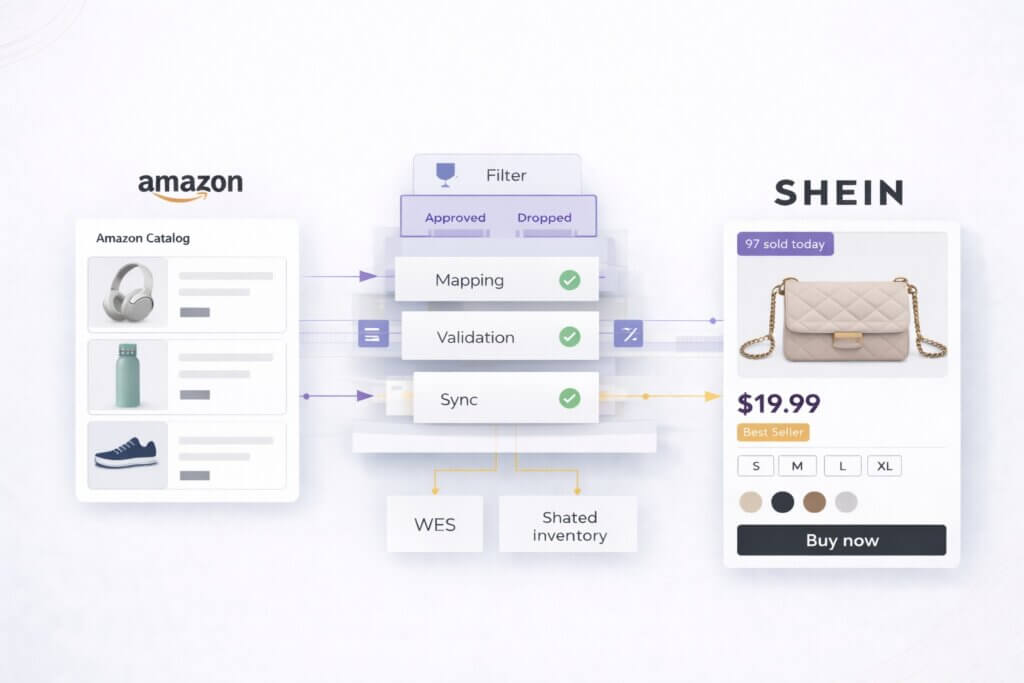


 Blog
Blog How to sell on Temu as an Amazon seller.
Selling on Temu is less about getting products listed and more about whether your margins can survive the platform. Here’s how Amazon sellers can stay profitable while operating across systems.

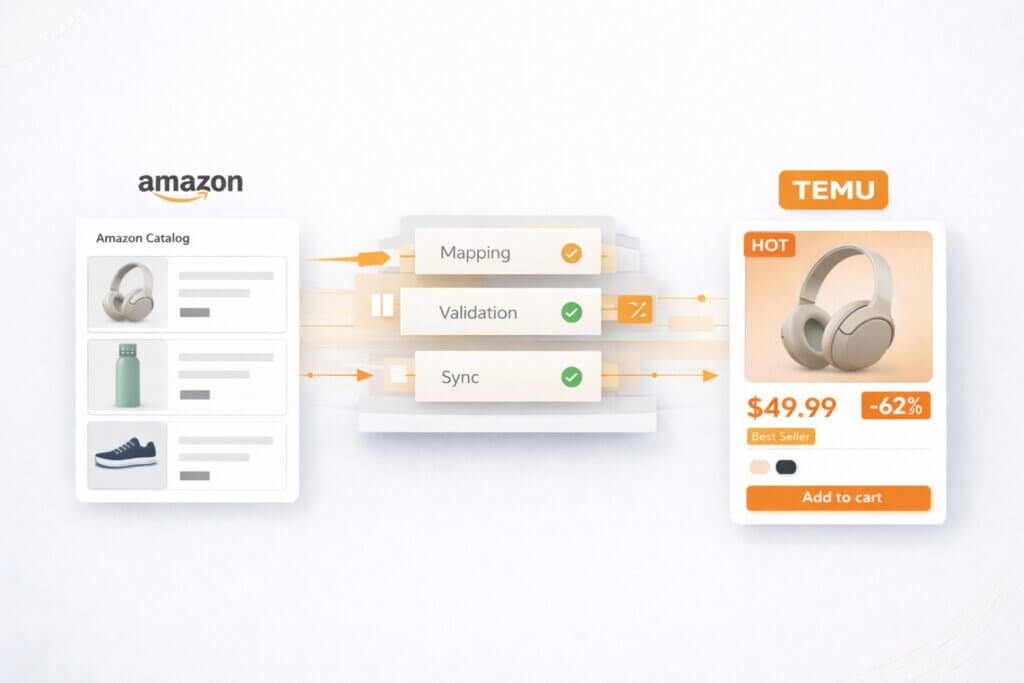
Selling on Temu is less about getting products listed and more about whether your margins can survive the platform.
Temu is built around aggressive pricing. If your costs don’t support competitive pricing, visibility drops quickly, and the channel stops working.
Most sellers don’t struggle with setup. They struggle when pricing, fulfillment, and returns start compressing margins in ways their Amazon model wasn’t built for.
To sell on Temu as an Amazon seller, you need to:
- adapt your catalog to Temu’s structure
- choose the right seller model
- meet strict shipping requirements
- keep inventory and orders aligned across channels
The challenge isn’t getting live. It’s staying profitable while operating across systems.
Why Temu matters now.
Temu scaled rapidly through 2024 and into 2025, becoming one of the largest global ecommerce platforms by order volume. For US-based Amazon sellers, the opportunity shifted in mid-2025.
The US ended the de minimis exemption for many Chinese imports. That made direct-from-China fulfillment less cost-efficient for Temu’s original supply base. In response, Temu expanded its focus on domestic sellers who can fulfill locally.
That shift matters. Temu is now actively prioritizing faster domestic delivery and more reliable fulfillment. Amazon sellers already have those capabilities.
The opportunity exists, but it comes with different constraints.
The two seller models.
Temu offers two ways to sell, and the choice directly affects your margins and control.
The consignment model is Temu-managed, like Amazon Vendor Central. You send inventory to Temu, and they handle pricing, fulfillment, and customer experience. You’re paid a wholesale price.
This removes operational work but limits control. Pricing is set by the platform, and margins depend on the wholesale terms you negotiate.
The local seller model is closer to Amazon Seller Central. You control pricing, listings, and fulfillment. Commission rates are higher, but you retain control over your unit economics.
The tradeoff is operational. Orders must be shipped quickly, tracking must be provided promptly, and delivery timelines must be met consistently. Failure to meet these requirements affects performance and visibility.
For most Amazon sellers, the local model aligns better with existing operations, but it requires tighter execution.
Pricing is the constraint.
This is where Temu differs most in practice.
Visibility is closely tied to pricing relative to similar listings. Other factors still matter, but they have less ability to offset a pricing gap.
This doesn’t mean every product needs to be the cheapest. But it does mean product selection becomes critical. The products to sell on Temu are:
- items with strong margins
- bundles that maintain perceived value
- in categories where fast domestic shipping creates an advantage
Before listing, run the numbers per SKU. Factor in commission, shipping costs, and return exposure.
If the margins don’t hold at competitive pricing, don’t list that SKU on Temu.
This is where Temu differs from other expansion paths. On Walmart, pricing still matters, but fulfillment and Buy Box positioning play a larger role. On TikTok Shop, product selection and content format often matter more than pure price.
The catalog translation problem.
Once pricing makes sense, listings become the next constraint.
Temu uses a different category structure, different required attributes, and different variation rules. An Amazon listing won’t transfer directly.
Some differences are straightforward. Field names and required attributes vary. Others are structural. Variation options are limited and category-specific.
There are also requirements that don’t exist on Amazon. These can include import designation fields, compliance attributes, trademark verification, and packaging data used for shipping calculations.
In regulated categories, compliance requirements have become stricter. Missing or incorrect data leads to rejections or removals.
At small scale, this is manageable with manual processes. But at larger scale, it becomes the main bottleneck.
When your catalog size grows, the question isn’t how to map attributes. It’s how to maintain those mappings.
Most sellers operating at scale use automation tools to handle mapping and validation. CedCommerce by Threecolts is one example. It maps attributes between Amazon and Temu, suggests mappings based on category context, and validates listings before submission.
Validation is critical. Fixing issues before submission is significantly easier than resolving problems after listings are live.
Fulfillment: Amazon MCF is an option.
If you’re already using FBA, Amazon Multi-Channel Fulfillment can be used to fulfill Temu orders.
Orders from Temu are routed to Amazon’s fulfillment network and shipped from your existing inventory.
The setup requires alignment. Carrier names, tracking formats, and delivery timelines need to match Temu’s requirements. If they don’t, orders may be penalized.
Cost is the main consideration. MCF is typically more expensive per unit than standard FBA. On Temu, where pricing pressure is higher, this has a larger impact on margins.
Temu often expects sellers to offer competitive or free shipping, which means shipping costs need to be factored into pricing.
For some sellers, a 3PL or self-fulfillment setup can be more cost-effective. The right approach depends on your cost structure.
Inventory sync: the same risk, higher impact.
Inventory becomes harder to manage once Temu is added alongside Amazon.
If both channels draw from the same stock, timing matters. A delay in updating availability creates oversells, which lead to cancellations and performance penalties.
Returns complicate this further. Stock can come back into inventory long after the original sale, and your system needs to account for that.
What matters is maintaining a single, accurate view of inventory across channels.
The synchronization problem isn’t unique to Temu. It becomes more pronounced as you add channels like SHEIN or TikTok Shop, each with its own return behavior and demand patterns.
CedCommerce does this by syncing changes as they happen, resolving conflicts automatically, and retrying failed updates so inventory stays consistent.
Without that, you’re relying on periodic updates, which introduces gaps that grow as order volume increases.
Managing order flow.
Order handling on Temu adds another layer to your existing workflow.
You must capture orders, route them correctly, and return valid tracking in Temu’s required format.
Where things break is in the handoff between systems. Orders can fail before fulfillment, get rejected due to mismatches, or never return tracking.
These problems often show up after the fact, as missing orders or delayed updates rather than immediate errors.
CedCommerce reduces this risk by retrying failed orders and tracking their status until they’re completed or flagged.
Without that, you’re left reconciling orders manually, which becomes unmanageable as volume grows.
What to list first.
Don’t list your full catalog.
Start with 50 to 100 SKUs. Focus on products where pricing works and operational complexity is low.
Look for:
- margin flexibility
- lower return risk
- straightforward compliance requirements
This allows you to validate pricing, fulfillment, and inventory behavior before scaling.
Once the system is stable, expanding the catalog becomes incremental.
A realistic timeline.
For sellers using multichannel infrastructure to handle catalog mapping and sync, a typical rollout looks like:
Days 1–2: Register and complete onboarding. Submit documentation.
Days 3–5: Connect your catalog, configure attribute mapping, and fill required fields.
Days 5–8: Submit listings and resolve validation issues.
Days 8–14: Listings go live. Validate fulfillment, tracking, and inventory sync.
Without a platform handling mapping, sync, and order flow, this process stretches into weeks of manual work and rework.
What this comes down to.
Temu is not a channel you grow into. It’s a channel your economics either support or don’t.
Your catalog and infrastructure carry over, but your margins are under more pressure. Pricing, fulfillment, and returns all have a direct impact on whether the channel works.
The sellers who succeed make deliberate decisions about what to list, how to price, and how to operate across channels without losing control of their numbers.
That requires more than setup. It requires a system that keeps operations and economics aligned.