
 Margin Pro
 Retail 365
 AI Operator
 Seller 365
 UniCon
 Onsite Support


 Blog
Blog How to expand from Amazon to Walmart Marketplace.
Walmart is the closest marketplace to Amazon, but it operates with stricter requirements. Here’s how you can start selling on Walmart Marketplace.

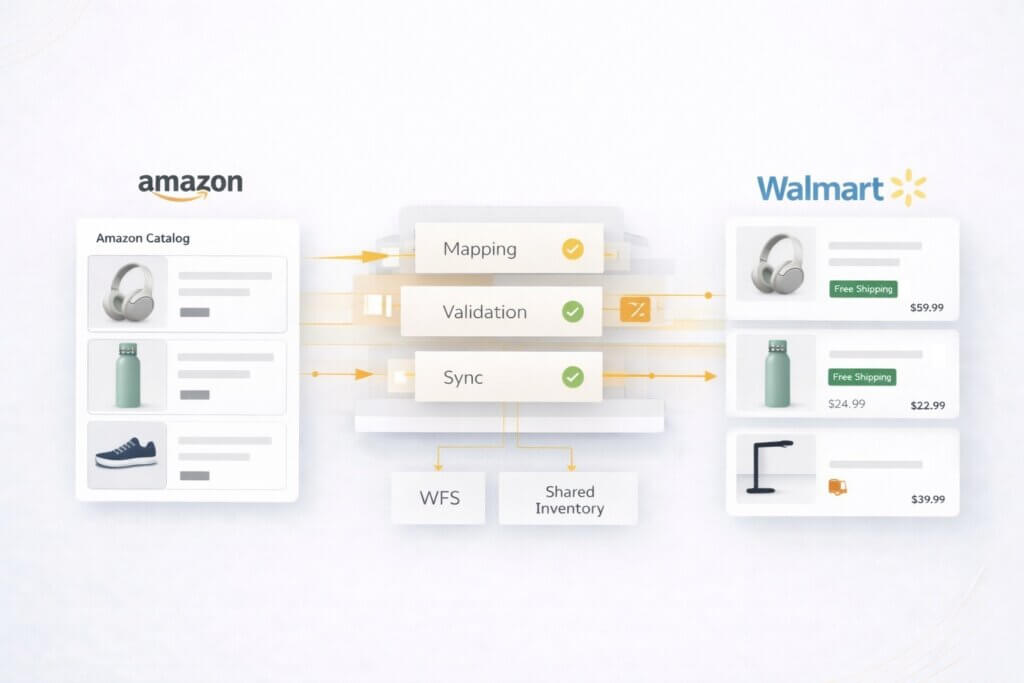
Walmart is the closest marketplace to Amazon, but it operates with stricter requirements.
Approval is selective, listings must meet structured standards, and visibility depends heavily on price and fulfillment performance. What works on Amazon doesn’t automatically translate.
Sellers run into problems when listings don’t meet Walmart’s requirements, inventory falls out of sync, or fulfillment doesn’t support Buy Box competitiveness.
To sell on Walmart Marketplace, you need to:
- adapt your catalog to Walmart’s structure and requirements
- meet approval and compliance standards
- set up fulfillment that supports Buy Box positioning
- keep inventory and orders aligned across channels
The challenge isn’t launching. It’s meeting Walmart’s standards consistently at scale.
Why Walmart is the most natural expansion.
Walmart is the closest operational match to Amazon. And the second-largest marketplace in the world.
It’s also still growing and less saturated. That means competition is lower, and strong Amazon products often gain traction quickly because there’s less noise.
But that opportunity depends on structure.
Walmart behaves more like a retailer than an open marketplace. It expects clean data, consistent fulfillment, and reliable performance from day one.
Approval is the first filter.
Walmart doesn’t accept every seller.
You need a registered business, valid product identifiers (GS1 UPC/GTIN), and a track record of ecommerce performance. Your Amazon history is part of the evaluation.
You also need to demonstrate that you can fulfill orders quickly and consistently from US-based inventory.
This filters out early-stage sellers. Walmart is designed for operators who already have stable systems in place.
The fee structure is simpler.
Walmart’s fees are straightforward.
There’s no monthly subscription fee. Referral fees range from 6% to 15%, depending on category. In some categories, total costs are lower than Amazon’s.
But the potential for higher profit margins doesn’t determine success.
Walmart rewards operational consistency. Listings, pricing, fulfillment, and availability all directly affect visibility and Buy Box eligibility.
Listing requirements: structure and compliance matter.
Your Amazon listings won’t transfer directly.
Walmart requires valid UPC/GTIN identifiers. Products without them can’t be listed. This is a hard constraint that doesn’t exist on Amazon in the same way.
Listing structure is also different. Titles, descriptions, key features, and attributes must follow Walmart’s taxonomy.
Image requirements are stricter. Walmart expects clean, white-background images that meet specific standards.
Walmart also assigns a Listing Quality Score. This measures completeness, discoverability, and performance. And it directly impacts visibility.
For a small catalog, this is manageable manually. At scale, it becomes a bottleneck.
The challenge isn’t just listing products once. It’s maintaining listing quality as your catalog changes.
Every marketplace has its own requirements. TikTok Shop focuses on categories and attributes, while SHEIN applies stricter formatting rules across titles and images. If each channel has its own version of your catalog, inconsistencies build quickly.
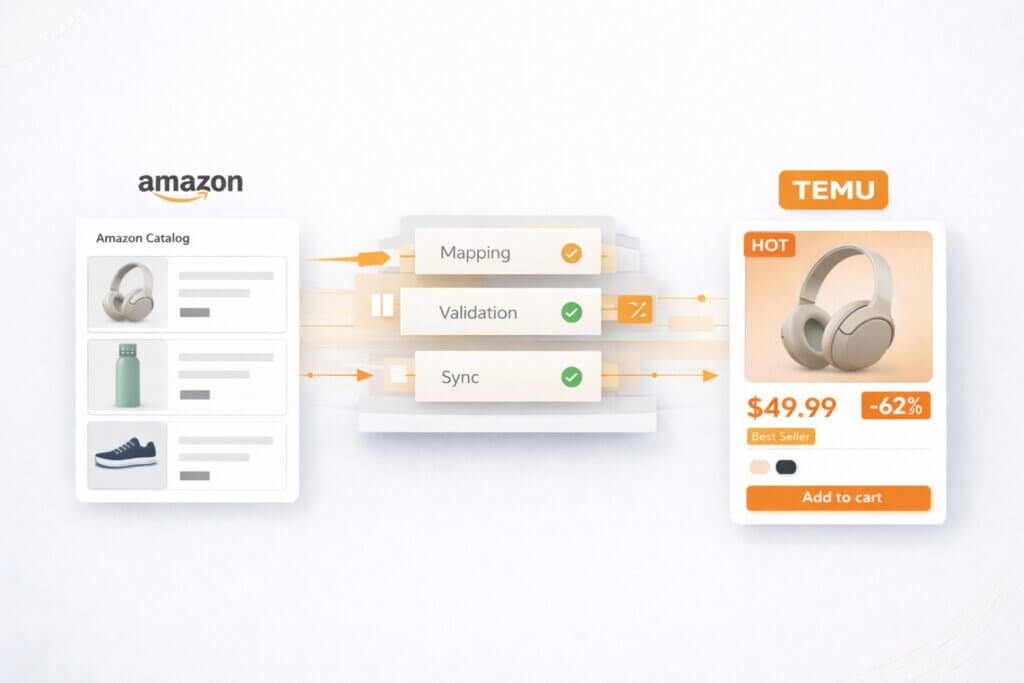
Most sellers operating across channels use tooling to handle this. CedCommerce by Threecolts maps your catalog into Walmart’s structure, validates listings before submission, and maintains those mappings over time.
Fulfillment: Buy Box vs inventory efficiency.
Fulfillment decisions directly affect visibility on Walmart.
Walmart Fulfillment Services (WFS) is the closest equivalent to FBA. Products fulfilled through WFS get two-day delivery tags and stronger Buy Box positioning.
But WFS changes how you manage inventory.
If you use WFS, you’re typically holding separate inventory for Walmart and Amazon. That improves performance on each channel, but increases total inventory requirements and working capital.
The alternative is shared inventory.
Amazon MCF or a 3PL lets you fulfill Walmart orders from the same inventory pool you use for Amazon. This reduces inventory overhead and simplifies replenishment.
But it comes with tradeoffs. You may have weaker Buy Box positioning, and you need to meet Walmart’s carrier and delivery requirements consistently.
This kind of trade-off doesn’t show up the same way on every platform. On Temu, pricing pressure is the primary constraint. On TikTok Shop, the complexity is more in catalog structure and synchronization.
As you scale across channels, the problem shifts from fulfillment setup to coordination.
Which orders are fulfilled from which inventory pool, how delivery promises are met, and how costs are managed all need to be consistent.
That routing needs to be managed centrally. Platforms like CedCommerce apply consistent fulfillment logic across channels so orders are routed correctly based on inventory, location, and delivery requirements.
Inventory sync: shared vs split inventory.
Once you’re selling on both Amazon and Walmart, inventory becomes a structural decision.
If you use WFS, you’re operating with separate inventory pools. This reduces cross-channel sync risk, but increases total inventory requirements and the chance of stock sitting idle in one channel.
If you use shared inventory through MCF or a 3PL, you reduce inventory overhead. But you introduce synchronization risk across channels.
You would have multiple marketplaces drawing from the same stock. If inventory doesn’t update in real time, you oversell. That leads to cancellations and performance issues.
Returns add another layer of complexity to shared inventory. Items can re-enter stock at different times depending on the channel.
When using MCF or a 3PL, your system needs to maintain a consistent inventory state across:
- sales
- returns
- reservations
- failed operations
The only reliable approach is real-time synchronization.
CedCommerce maintains a single inventory state across channels. When stock changes, updates propagate immediately, and failed operations are retried so inventory stays accurate.
Without that, inventory drift becomes unavoidable as volume increases.
Managing order flow across Amazon and Walmart.
Selling on Amazon and Walmart means managing multiple order workflows.
Those workflows depend on your fulfillment model. Separate inventory creates simpler routing per channel, while shared inventory requires orders to be routed dynamically across systems.
In either case, managing these flows can create fragmentation as volume increases.
Each order must be captured, routed to the correct fulfillment source, and returned with valid tracking in Walmart’s required format.
In practice, failures happen. Orders can fail to reach fulfillment, be rejected due to mismatches, or fail to return tracking correctly.
These issues don’t always surface immediately. They show up later as missing orders, tracking delays, or drops in performance metrics.
CedCommerce handles this through automatic order retry and structured error handling. Failed orders aren’t dropped. They’re retried, tracked, and surfaced when intervention is needed.
Without that, order handling becomes a fragmented, manual reconciliation process across systems.
What to launch first.
As Walmart Marketplace is so similar to Amazon, it doesn’t require a cautious, SKU-by-SKU rollout the way newer marketplaces do.
If your catalog is already performing on Amazon and your data is clean, you can launch at scale.
The limiting factor isn’t demand. It’s about whether you can translate your catalog so your listings meet Walmart’s requirements and your inventory and order flow stay consistent across both channels.
For smaller or less structured catalogs, starting with 50–100 SKUs still makes sense to validate your setup.
But for established sellers with large catalogs, full or near-full catalog launches are realistic.
The constraint is operational. Mapping thousands of SKUs into Walmart’s structure, maintaining listing quality, and keeping inventory and orders aligned across channels requires a system.
This is where tooling becomes critical. CedCommerce enables large-scale catalog launches by handling attribute mapping, validation, and synchronization across channels, turning what would be months of manual work into a controlled rollout.
Stadium Goods launched over 75,000 SKUs on Walmart in under 10 days using CedCommerce. That’s not achievable with manual workflows.
A realistic timeline.
For sellers using a multichannel platform to handle catalog mapping and synchronization, a typical rollout looks like:
Week 1: Apply and complete Walmart onboarding. Prepare your catalog in parallel, verify UPCs, and define your fulfillment approach (WFS vs shared inventory).
Week 1–2: Connect your catalog to your multichannel platform, configure mapping, and prepare listings at scale. Large catalogs can be processed in parallel rather than staged.
Week 2–3: Submit listings and resolve validation issues. This is where most delays occur, driven by data quality and compliance, not volume.
Week 3–4: Listings go live. Validate fulfillment routing, tracking, and inventory synchronization across all SKUs.
Without a system handling catalog translation and synchronization, the same process takes significantly longer due to manual mapping and ongoing maintenance.
What this comes down to.
Walmart Marketplace is a scalable extension of Amazon, but it introduces different operational trade-offs.
You can optimize for performance with WFS, or for efficiency with shared inventory. Both approaches work, but both require coordination as you scale.
Your catalog, inventory, and fulfillment don’t need to be rebuilt. They need to be managed across systems with consistent data, accurate inventory, and reliable order flow.
The sellers who succeed build that coordination into their operations from the start.
Platforms like CedCommerce enable this by acting as the system between your catalog and each marketplace.
Without that, scale creates complexity instead of leverage.