

 Blog
Blog Amazon Best Seller Rank (BSR) explained
Amazon’s Best Seller Rank is your data-backed shortcut to understanding product demand and optimizing sales strategy.


Amazon’s marketplace moves fast. Really fast. With small- and medium-sized businesses selling around 4,000 products per minute, standing out feels impossible. That’s where Amazon’s Best Seller Rank comes in.
Think of BSR as Amazon’s popularity contest for products. It tells you how well your item sells compared to everything else in its category. The lower your number, the higher your rank. Simple enough, right? But here’s the thing most sellers miss: BSR isn’t just a vanity metric. It’s a roadmap to understanding what customers actually want to buy.
Mastering BSR can transform your Amazon business from struggling to survive into thriving consistently. Let’s break down how this ranking system really works and how you can use it to your advantage.
Understanding Amazon’s Best Seller Rank
Amazon defines BSR as a metric that indicates how an item sells compared to other items in the same category. It displays the bestsellers for each featured category in near real-time, so it’s updated many times throughout the day.
The lower the score, the higher the Amazon sales rank. For example, if your store’s iPhone case ranks #5 in the BSR for Cell Phones & Accessories, it means it’s the 5th bestselling item in that category.
You can see the BSR ranking of an item on the Product Details page when you scroll down to the Product Information section.
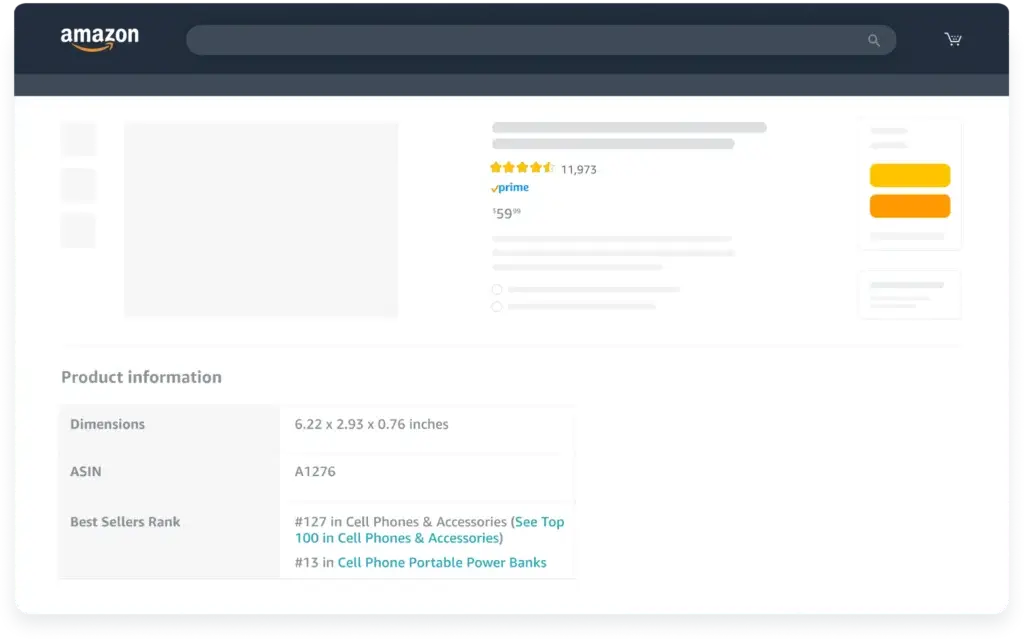
As the image shows, an item can have more than one BSR, particularly if it’s listed in multiple categories. Some products may not have a BSR, a typical case for electronics, though you’ll still see the items in the Best Sellers list.
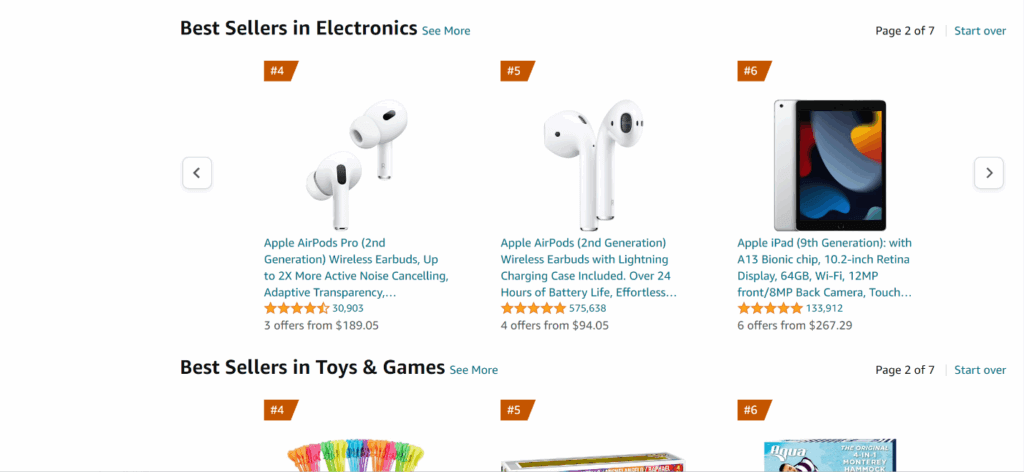
The image below shows the Product Information for Apple AirPods Pro. It doesn’t have the BSR details, yet the product is still displayed as the number 4 best seller in the electronics category.
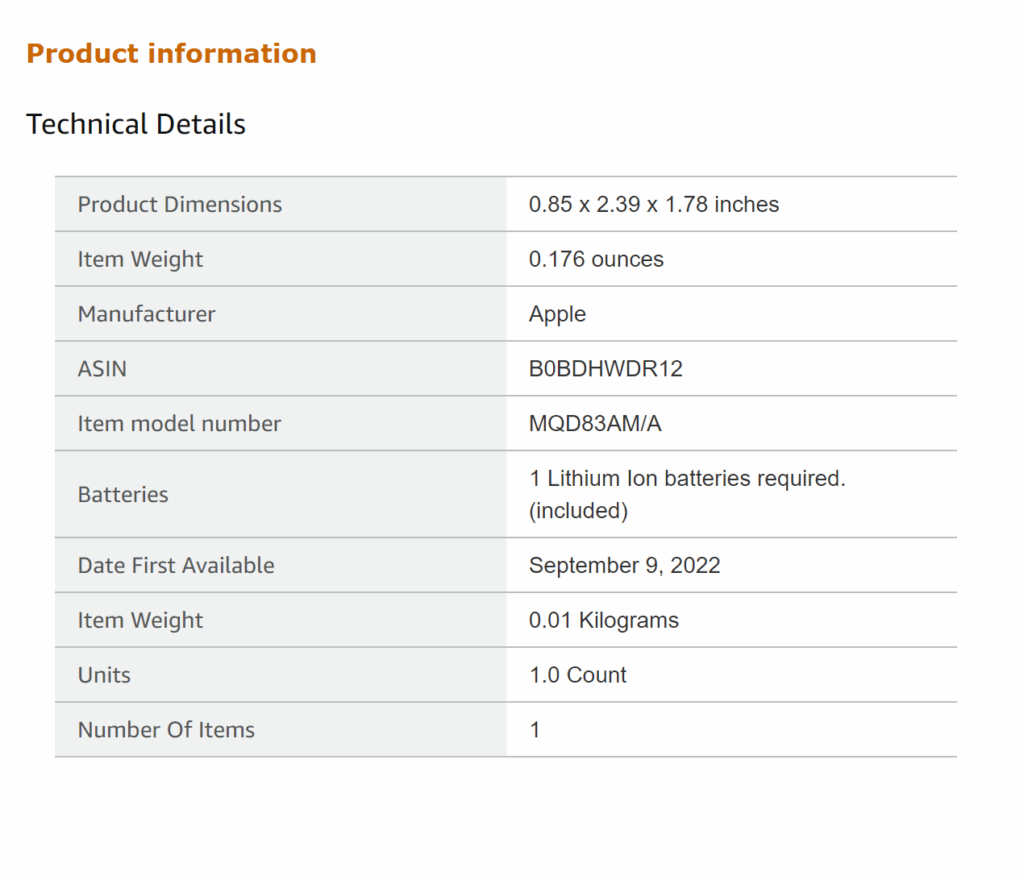
Amazon Best Seller Rank indications
The Amazon BSR only points out how well a product sells overall. It’s not a metric for determining the product’s quality. Moreover, it doesn’t always show how a product sells in relation to the same products. That’s why some items have more than one BSR. It allows buyers and sellers to identify the exact category where the product really stands out. For example, an item ranking #2563 in the Clothes, Shoes, & Jewelry category may rank #50 in Women’s Tunics.
The BSR ranking is unrelated to a product’s page view data or customer reviews. An item with several positive reviews isn’t necessarily a top seller; likewise, a product with significant page views isn’t automatically a best-selling item compared to its rival products.
Lastly, an item’s BSR may vary depending on the Amazon store. For instance, an item that ranks #10 in the United States may have a higher or lower ranking in the United Kingdom.
Factors that determine an Amazon product’s Best Seller Rank
Amazon awards a BSR to an item based on the following factors:
- Sales volume data over the past two years
- Recent sales
- All-time sales
- Pricing
- Marketing methods
- Competition
Recent sales have a higher impact on the BSR than historical sales. That’s why a product’s BSR changes frequently. However, it doesn’t change with every sale. For example, if you sell 15 iPhone cases in one hour and only 10 in the following hour, the item’s BSR won’t necessarily decline. The BSR algorithm will consider both factors for the next ranking update.
How to track Amazon Best Seller Rank
You can see the live Best Sellers List by accessing this page. It shows the most popular products for each featured category in chronological order. You can also go to the Amazon homepage, choose any category from the menu, click “Sort by:” on the top-right corner of the screen, and select “Best Sellers.”
Here are other tips on keeping track of the Best Sellers List:
Check out customer reviews
Look for products in your business’s category and read customer reviews. It will help you identify the product’s strengths and weaknesses and compare them to your item.
If you notice a lot of faults, you may also be able to spot patterns in the complaints. For example, if customers frequently complain of the product’s flimsy material, perhaps you can create an alternative with a more robust material and outperform your competitor.
Compare sales metrics to BSR scores
Use your Seller Central account to view and monitor key metrics and KPIs, such as Impressions, Clicks, Clickthrough Rate, Purchases, and Return Buyers. Compare these metrics to your products’ BSR scores to gain valuable insights on promoting your business and expanding its reach. Growth in sales metrics and BSR scores may let you know which products to focus on, while declining figures may signify that you need to phase out poorly performing products.
Conduct keyword research
Your competitors’ products may be selling better than yours because they utilize keywords customers use to search for items in your business’s category. To research keywords, type various words and phrases in the Amazon search box. Look at the suggestions in the drop-down selection and create a list of relevant keywords for related listings.
You can also experiment with similar searches to discover what’s already out there and compare search items to determine which keywords generate the most accurate results.
If you have a Professional plan in Seller Central, you can unlock Brand Analytics to conduct more streamlined keyword research and access reports on search catalog performance, audience demographics, and more. There are also several free Amazon product research tools that can help you with this process.
Monitor your BSR through Seller Central
If you’re a registered seller in Seller Central, you can view your products’ BSR scores even without access to Brand Analytics. Click Reports from the top menu on your dashboard and select Business Reports. Go to Inventory in Stock and find the Sales Rank column to view BSR scores.
How to improve your Amazon product’s Best Seller Rank
Amazon recommends the following techniques to improve your product’s BSR score:
1. Select product categories deliberately
It’s crucial to choose the category of your listing with deliberation because Amazon BSR scores rise and fall relative to the items within the same category.
Explore the Best Sellers list to accurately identify the category and subcategory of the item you want to list. If your product has variations, assign the parent Amazon Standard Identification Number (ASIN) and all child ASINs in the same category.
2. Optimize Amazon listings
Optimizing your listings increases their visibility and search ranking. Focus on the seven most critical aspects of a listing: keywords, images, titles, pricing, descriptions, key features, and backend search keywords.
Here’s an overview of the steps to optimizing your Amazon listings:
- Leverage popular keywords related to your product (short-tail and long-tail keywords).
- Make product titles less than 80 characters and begin with the brand name.
- If applicable, opt for numerals in the product title (“5” instead of “five”).
- Include brand names, sizes, material types, and other relevant details in the product description.
- Use A+ Content (formerly Enhanced Brand Content) to incorporate a brand story, high-quality images, and strategic text placements into your listings.
- Run A/B tests on your listings to compare different versions of a product title, image, or any other vital elements and pick the option that can drive more sales.
- List the product features in bullet points.
- Upload 500 x 500 or 1,000 x 1,000 px images with a plain white background.
- Optimize backend search terms to allow Amazon to index all your keywords even if the buyers can’t see them.
3. Price your products competitively
Monitor your competitors’ pricing and experiment with different amounts to identify the price that pulls in the most sales. You can also use a repricing tool to make the prices of your products automatically adjust depending on the trend.
4. Increase marketing and advertising efforts
Promote your products on multiple channels, including social media, search engines, blogs, and more. Boost customer retention by offering cost-effective subscription boxes, bundles, and other incentives. Amazon also offers exclusive advertising options for their sellers, so check that out.
5. Engage with your customers
Ensure a smooth and excellent customer experience from browsing to delivery. Provide complete product information, answer questions quickly, and respond to reviews, including positive ones. Additionally, be active on social media so customers can reach you in other channels.
How to create a bestseller
Now that we know what kinds of products sell the most on Amazon, let’s figure out how to create a product that will dominate the Best Sellers List.
High demand, little to no competition, low seasonality, and the other factors previously mentioned determine the marketability and profitability of a product. Let’s form a more generalized idea of what type of products meet these criteria.
Commodities
Commodities are items everyone needs daily, like bath products, laundry products, salt, pepper, etc. They are available in many small and large retail stores without significant differences in price and quality.
However, despite their high demand, selling them on major marketplaces like Amazon can take time and effort. A solid branding strategy is key to making your commoditized product sell well. With tons of competitors on Amazon, you need to create a more personalized brand that incorporates your expertise, passions, and values into your product. Your marketing message should be carefully tailored to your target audience. You can utilize Seller Central to optimize your listing with a brand story and other essential elements.
Niche products
These are products available in only a few retail stores and have limited suppliers. They are usually handmade, which gives you a competitive advantage. The downside is that niche products are typically more expensive than commodities, making their market relatively small.
Amazon offers a space for handmade products on Amazon Handmade. Artisans from over 80 countries are currently registered sellers. To join, sign up to Seller Central, and once your account has been approved, send your application to Amazon’s artisan-only community.
Handmade-approved applicants enjoy the benefit of a waived Professional Selling Fee, allowing them to save $480 per year. In addition, when you sell a handmade product, Amazon will deduct a 15% referral fee.
Create a product you’re passionate about
You can only sell a product more easily if you’re passionate about it. This approach may be a little risky, but with sufficient knowledge about the market and running a business, you can form a feasible plan and identify the right market.
If your product is related to a hobby or activity you enjoy, your community of like-minded people can be your customers. Just make sure that your product solves a problem or enhances one’s quality of life for it to be valuable for your customers.
The numbers don’t lie, but they don’t tell the whole story either
Amazon Best Seller Rank gives you valuable intel about where your products stand in the marketplace. It shows you which direction the competition is heading and helps you spot opportunities others might miss. But remember this: BSR tracks past performance, not future potential.
The real winners combine BSR insights with smart product research, competitive pricing, and killer marketing. They don’t just chase rankings—they understand what drives them. Sales velocity, customer satisfaction, and market positioning matter more than any single metric.
Your BSR score today reflects yesterday’s decisions. The question is: what decisions are you making today to improve tomorrow’s rankings? Focus on serving customers better, optimizing your listings smarter, and choosing products that solve real problems. The rankings will follow.
Ready to find your next bestseller? Seller 365 gives you everything you need to research profitable products:
- Tactical Arbitrage helps you discover opportunities across 1,500+ online stores.
- For retail scouting, Scoutify delivers instant profit calculations in any store aisle.
- Book flippers should check out ScoutIQ for lightning-fast scanning and profit analysis.
- And ScoutX transforms every Amazon product page into a complete research command center.
Plus, you also get six more solutions for other parts of your business. All for the price of one—$69 per month. Try it free today!