
 Margin Pro
 Retail 365
 AI Operator
 Seller 365
 UniCon
 Onsite Support


 Blog
Blog The real cost of multichannel expansion in 2026
Most sellers think they understand the cost of multichannel expansion. But the real cost isn’t fees, it’s the work to get live and stay live. Here’s how to minimize those hidden costs.

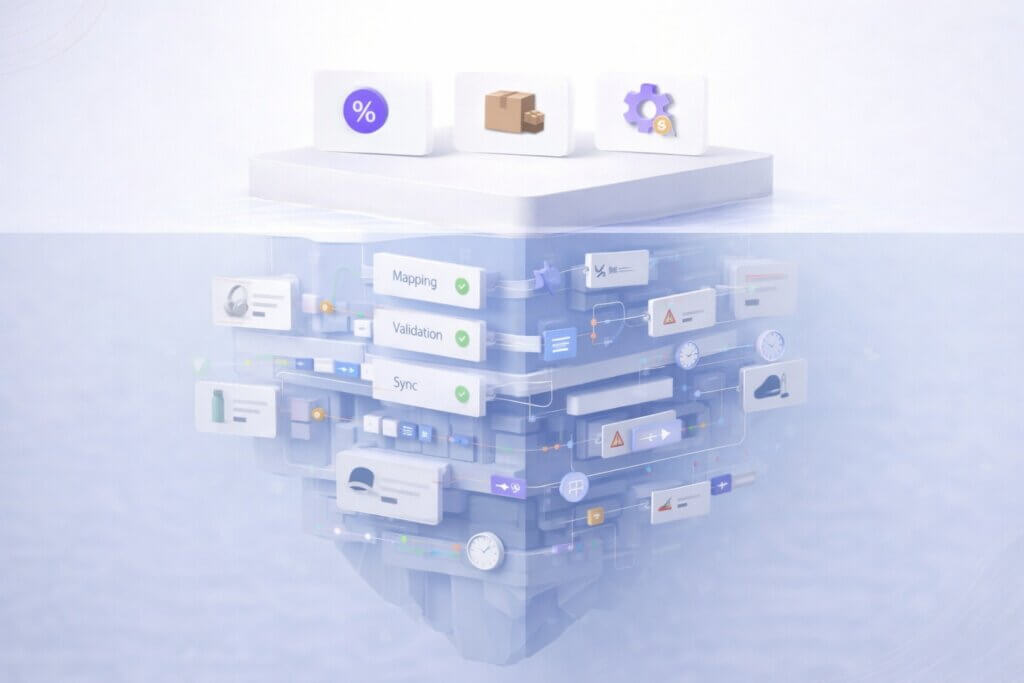
Most sellers think they understand the cost of multichannel expansion.
They compare marketplace fees, look at commission rates, estimate fulfillment costs, and factor in a tool subscription. On paper, the math looks simple.
Then they start. And very quickly, the model breaks.
That’s because the real cost doesn’t show up in fees. It shows up in the work required to get live and stay live across multiple channels.
This isn’t a warning against multichannel. Sellers operating across multiple marketplaces consistently outperform single-channel sellers in both revenue and customer lifetime value.
It’s a reminder that the visible costs aren’t the ones that determine success.
The costs sellers focus on first
When evaluating a new marketplace, most sellers start with the obvious line items.
Marketplace commissions are the easiest comparison. Amazon averages around 15%, Walmart ranges from 6–15%, and TikTok Shop typically sits lower at 5–8%. On paper, expanding often looks like a margin opportunity.
Fulfillment is next. If you’re using FBA, you already understand the baseline. Off-Amazon orders introduce either an MCF premium—roughly $0.35–$0.41 per unit on top of FBA fees as of 2026—or 3PL costs, typically $3–$8 per order depending on size and weight.
Then there are multichannel tool fees. Crosslisting software starts around $20–$50/month. Mid-market automation platforms range from $99 to $999/month. Enterprise management systems can reach $1,500–$6,000+ per month, often with additional revenue-share fees layered on top.
At this point, the conclusion usually looks straightforward: lower commissions and manageable tooling will drive incremental revenue.
But that’s not how it plays out in practice.
The mistake isn’t looking at these costs. It’s assuming they tell the full story.
Where the real cost shows up
The biggest costs in multichannel expansion are operational.
They don’t appear in pricing pages. They show up in time, labor, and delay. And they tend to compound quickly once you start scaling across multiple marketplaces.
1. Catalog translation (the biggest hidden cost)
Every marketplace speaks a different language.
Categories, attributes, variation logic, and content requirements vary from one channel to another, so Amazon data doesn’t transfer cleanly to TikTok Shop, Temu, or SHEIN.
In practice, you’re not uploading your catalog, you’re rebuilding each listing in a new format.
That includes:
- Mapping attributes across schemas
- Filling in missing data
- Restructuring variations
- Formatting content to match each marketplace’s rules
All this adds up quickly, especially when you’re working across multiple categories and channels.
At a conservative estimate of 15–30 minutes per SKU, a 1,000-SKU launch requires 250–500 hours of work.
At $25–$50/hour, that translates to:
- $6,000–$25,000 per channel
- $18,000–$75,000 across three channels
And that’s before anything goes live.
2. Listing rejection cycles
Catalog work doesn’t end when you upload.
Every marketplace validates listings, and many fail on the first pass.
They don’t fail because the product is wrong, but because the structure, formatting, or category logic doesn’t match the platform’s requirements.
So the process becomes iterative: you upload listings, receive rejections, diagnose the issues, fix them, and resubmit. Then another round fails for different reasons.
Each cycle can add 2–5 days, which is how a “two-week launch” quietly turns into a two-month project.
The cost isn’t just the rework. It’s the compounding delay in getting to market.
3. Inventory sync failures
This is where small issues become expensive. If inventory isn’t synced in real time, you oversell.
A unit sells on Amazon, but another channel still shows it as available, resulting in an order you can’t fulfill.
The immediate outcome is a canceled order. The longer-term impact is more serious: damaged seller metrics, reduced visibility, and slower growth on new channels where early performance matters most.
A handful of avoidable cancellations at launch can set you back significantly.
4. Ongoing maintenance
Multichannel expansion isn’t a one-time setup, it’s an ongoing operational system.
Marketplaces regularly change their requirements, from category structures to attribute definitions and fee models. Each change creates work: updating listings, adjusting mappings, and ensuring everything stays aligned.
For many sellers, this becomes 5–10 hours per week just to maintain stability.
Over a year, that’s 260–520 hours or roughly $6,250–$26,000 per channel, before accounting for any growth initiatives.
5. Time to market (the most underestimated cost)
This is the cost most sellers don’t model. And it’s often the most significant.
Every week you’re not live is a week you’re not generating revenue.
If a new channel produces even $300–$500 per day, a one-month delay costs $9,000–$15,000 in lost revenue, while a three-month delay can exceed $30,000–$45,000.
Implementation speed isn’t just an operational detail, it’s a revenue lever.
The total cost reality
When you combine catalog work, rework cycles, ongoing maintenance, and delayed launch timelines, the true cost of expanding to a new channel often reaches tens of thousands of dollars before meaningful revenue begins.
This is where most business cases break. Not because the opportunity isn’t there, but because the cost structure wasn’t fully understood upfront.
What this means in practice
At this point, the question changes.
It’s no longer “what does this channel cost?” but “how much operational work does this add?”
Because that’s what actually drives total cost.
Two sellers can expand to the same three marketplaces and end up with completely different outcomes. One absorbs the cost through labor and delay, while the other minimizes that cost with systems that reduce the work and accelerate time to market.
The difference isn’t the marketplaces, it’s how you do the work.
Where multichannel tools fit
Multichannel tools don’t reduce marketplace fees or replace fulfillment. What they do is change how you handle operational work across three areas:
- Catalog translation
- Inventory synchronization
- Ongoing maintenance
The more a platform automates these processes, the more it reduces your manual labor costs.
The three cost models
In practice, most sellers end up operating within one of three models.
1. Manual approach
- Platform cost: $0
- Catalog work: highest
- Maintenance: highest
- Time to market: 3–6 months
This approach looks inexpensive up front, but becomes costly once labor and delays are factored in.
2. Enterprise approach
- Platform cost: $24K–$72K+/year, plus revenue share
- Implementation: 2–4 months
- Operational burden: reduced
This model works well for ecommerce giants that want one platform to manage everything from advertising to listing. But it introduces high fixed costs and longer implementation timelines.
3. Mid-market automated approach
- Platform cost: $99–$999/month (no revenue share)
- Implementation: 1–4 weeks
- Catalog work: significantly reduced
- Maintenance: centralized and minimized
Platforms like CedCommerce by Threecolts sit in this category, focusing on reducing the largest cost drivers: catalog work, errors, and time to market.
How to calculate the real ROI
To build a realistic business case, you need three inputs.
Expected revenue.
A new channel typically generates 15–30% of your primary channel’s revenue within the first year.
Total cost.
Include tool fees, marketplace commissions, fulfillment, catalog labor, ongoing maintenance, and time to launch.
Payback period.
Divide the total cost by the expected monthly revenue. For most mid-market sellers using automated platforms, the investment pays back within 1–3 months after launch.
What this comes down to
Multichannel expansion doesn’t fail because of marketplace fees. It fails because the operating costs are higher than expected.
The biggest expense is catalog work. The second is time to market.
The seller who launches quickly with controlled operational costs will outperform the seller who optimizes for fees but takes months to go live.
Go multichannel.
Just make sure you understand where the cost actually comes from before you start.